
If you’re planning to launch an online store, one of the first questions you’ll probably ask is:
“How much does it cost to build an e-commerce store?”
The honest answer is: there isn’t one fixed price.
A simple online store can be built with a relatively limited budget, while another project may require custom design, payment and shipping integrations, inventory management, ERP or CRM connections, and custom business logic.
That means you might receive one quote for $X and another for several times that amount—and both could be reasonable depending on what’s included.
The difference isn’t simply “the website.”
It usually comes down to:
Technology + Design + Features + Integrations + Customization + Support + Complexity
In this guide, we’ll break down the real factors that affect e-commerce development costs in Egypt and explain how to determine the right budget for your project.
Is There a Fixed Price for an E-commerce Store?
No.
And this is one of the most important things to understand before asking a development company:
“How much is an online store?”
The phrase “e-commerce store” can describe very different projects.
For example, one business might need:
- A limited number of products.
- A simple design.
- Standard checkout.
- One payment method.
- Basic shipping.
- No complex integrations.
Another business might need:
- Hundreds or thousands of products.
- Product variations.
- Customer accounts.
- Multiple payment methods.
- Multiple shipping providers.
- ERP integration.
- CRM integration.
- Inventory management.
- Multiple languages.
- Multiple currencies.
- Custom business logic.
Both are called:
E-commerce stores.
Technically, however, they can be completely different projects.
How Much Does an E-commerce Store Cost in Egypt?
Instead of giving one misleading number, it’s better to think about projects based on their complexity.
Basic E-commerce Store
Suitable for a small business with straightforward requirements.
It may use a platform such as Shopify or WooCommerce with appropriate customization.
The cost can start at several thousand Egyptian pounds and increase depending on the design and functionality required.
Professional E-commerce Store
Designed for a company or brand with more products and more demanding requirements.
It may include:
- More advanced design.
- Better user experience.
- Greater customization.
- Payment integration.
- Shipping integration.
- SEO setup.
- Analytics.
- Additional integrations.
The final cost depends on the actual project scope.
Advanced or Custom E-commerce System
This is where the project has specialized requirements.
For example:
- Custom business logic.
- Internal systems.
- Multiple integrations.
- Dashboards.
- ERP.
- CRM.
- Marketplace functionality.
- Mobile application connected to the store.
These projects can require significantly larger budgets than a standard e-commerce website.
The important point: an accurate price should be based on the actual requirements, not simply the phrase “online store.”
What Determines the Cost of an E-commerce Store?
There are several factors that affect the final cost.
The most important ones include:
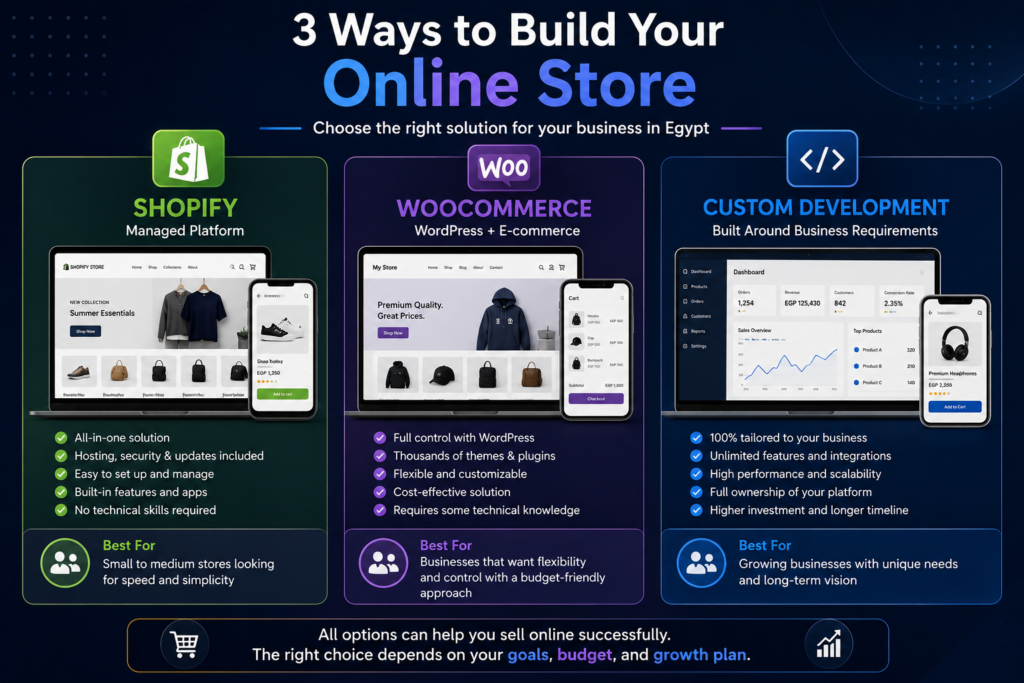
1. How the Store Is Built
Will you use:
Or:
Custom Development?
The technology itself can change both the initial development cost and the long-term operating model.
Shopify Cost
Shopify can be a good option if you want:
- A managed e-commerce platform.
- A relatively fast launch.
- Less responsibility for underlying infrastructure.
- An established e-commerce ecosystem.
But Shopify’s cost isn’t simply the subscription.
You may also need to consider:
Shopify Subscription
Design
Development
Apps
Domain
Payment Fees
Marketing
Maintenance
So it’s not accurate to simply say:
“Shopify is cheap.”
or:
“Shopify is expensive.”
You need to calculate the total cost of running the store.
If you’re considering Shopify, you can also read our Shopify Guide 2026 to understand the platform in more detail.
WooCommerce Cost
WooCommerce is open-source, but operating a WooCommerce store still involves additional costs.
You may need:
- Domain.
- Hosting.
- Theme.
- Plugins.
- Development.
- Security.
- Backups.
- Maintenance.
- Payment integration.
- Shipping integration.
So:
WooCommerce being open-source doesn’t mean the entire store is free.
The software itself is one part of the equation.
Building and operating the business is another.
Custom Development Cost
If the project requires Custom Development, the situation is different.
Instead of relying primarily on a ready-made platform, you can build the system around your business requirements.
This may make sense if you have:
- Complex business logic.
- Specialized workflows.
- A marketplace.
- B2B requirements.
- A custom pricing engine.
- Unusual user roles.
- Specialized integrations.
- Custom dashboards.
- A mobile application connected to the system.
However, Custom Development doesn’t automatically mean it’s the better option.
If Shopify or WooCommerce can handle your requirements effectively, using an existing platform may be more practical and less complex.
That’s why technology selection should start with requirements, not with the name of a technology.
You can learn more about this decision in our guide to WordPress vs Custom Development.
2. Store Design
Design is another important factor.
There’s a major difference between:
A ready-made theme with basic customization
and:
A fully custom-designed storefront.
Custom design may include:
- Homepage.
- Product pages.
- Category pages.
- Cart.
- Checkout.
- Customer account pages.
- Mobile design.
- Responsive design.
- UI components.
- Brand integration.
The more custom pages and components the project requires, the more design and development time it may take.
3. Number of Products
The number of products isn’t the only factor, but it can affect the project significantly.
Having:
20 products
is very different from:
2,000 products.
Especially when products include:
- Variations.
- Sizes.
- Colors.
- Attributes.
- Multiple images.
- Different pricing.
- Different inventory levels.
You should also ask:
Will products be added manually?
Or:
Will they be imported from a spreadsheet?
Or:
Does the store need an integration with an external system?
4. Payment Gateways
Payment is a core part of any e-commerce project.
You may need:
- Cash on Delivery.
- Online payments.
- Credit/debit cards.
- Digital wallets.
- Payment gateways.
- Multiple payment providers.
And the cost isn’t limited to development.
You also need to consider:
- Payment provider fees.
- Provider requirements.
- Platform compatibility.
- Settlement process.
- Checkout experience.
For businesses operating in Egypt, the payment gateway should be evaluated based on the actual business model and platform requirements.
5. Shipping
If you’re selling physical products, shipping is another major component.
A simple store might use:
A fixed shipping fee based on the customer’s location.
But a more advanced store might require:
- Multiple shipping providers.
- Shipping zones.
- Different shipping rates.
- Weight-based shipping.
- Location-based shipping.
- Tracking.
- Shipping company integrations.
The more complex the workflow, the more development may be required.
📷 Image Recommendation
Image idea: Customer order journey:
Product
→ Cart
→ Checkout
→ Payment
→ Shipping
→ Delivery
Alt Text:E-commerce customer journey from product selection to payment, shipping, and delivery
Suggested file name:ecommerce-customer-order-flow.webp
6. Integrations With Other Systems
This is one of the biggest factors that can increase project complexity.
Your store may need to integrate with:
- CRM.
- ERP.
- Accounting software.
- Warehouse management.
- Shipping companies.
- Payment gateways.
- Marketing platforms.
- WhatsApp.
- Mobile applications.
For example, when a customer places an order:
Store
↓
Payment
↓
Inventory
↓
ERP
↓
Warehouse
↓
Shipping
↓
Customer Notification
At this point, you’re no longer building “just a website.”
You’re building a business system.
7. Languages and Currencies
Will the store be:
Arabic only?
Or:
Arabic + English?
Will you sell:
In Egypt only?
Or:
Egypt + the Gulf + other markets?
If you need:
- Multiple languages.
- Multiple currencies.
- Multiple markets.
- Localized content.
The project can become more complex.
8. SEO
SEO isn’t simply installing a plugin or adding a meta description.
If you plan to generate organic traffic, SEO should be considered from the beginning.
This can include:
- URL structure.
- Category architecture.
- Product pages.
- Internal linking.
- Structured data.
- Page speed.
- Indexing.
- Canonical URLs.
- Duplicate content management.
- Image optimization.
- Content strategy.
This becomes especially important when the store has hundreds or thousands of products.
Fixing a poor site structure after launch can be much harder than planning it correctly from the beginning.
9. Performance and Speed
A slow e-commerce store can negatively affect the user experience and conversion process.
As you add:
- Products.
- Images.
- Apps.
- Plugins.
- Tracking scripts.
- Integrations.
Performance needs to be considered carefully.
Especially on mobile devices.
10. Maintenance and Support
The cost of an e-commerce project doesn’t necessarily end when the store goes live.
After launch, you may need:
- Updates.
- Security.
- Backups.
- Bug fixes.
- Performance monitoring.
- Plugin or app management.
- New features.
- Technical support.
This is especially important when the store is a core part of the business.
The Difference Between a Cheap Store and a Professional Store
Sometimes a client sees:
“E-commerce store for EGP 8,000.”
Then another company offers:
“EGP 20,000, EGP 30,000, or more.”
And naturally asks:
“Why is there such a big difference?”
The problem is that you’re often not comparing the same product.
A lower-cost store might include:
- Ready-made theme.
- Basic customization.
- Limited functionality.
- No complex integrations.
- No custom UX.
- No SEO strategy.
- Limited support.
A more expensive project may include:
- Custom UI.
- UX planning.
- Custom development.
- Integrations.
- SEO foundation.
- Performance optimization.
- Testing.
- Ongoing support.
So price alone isn’t enough.
The better question is:
“What exactly is included in the price?”
📷 Image Recommendation
Image idea: Split-screen comparison:
Basic Store
vs.
Professional E-commerce System
Compare:
Design / UX / Integrations / SEO / Support
Alt Text:Difference between a basic e-commerce store and a professional e-commerce system
Suggested file name:basic-vs-professional-ecommerce-store.webp
How Do You Determine the Right Budget?
Instead of asking:
“What’s the cheapest company that can build it?”
Start with these questions.
About the Business
- What are you selling?
- Who are your customers?
- B2B or B2C?
- Egypt only or international?
About the Products
- How many products?
- Product variations?
- Subscriptions?
- Physical or digital products?
About Operations
- How will inventory be managed?
- How will orders be managed?
- Is there an ERP?
- Is there a CRM?
About Payments
- Which payment gateway?
- Cash on Delivery?
- Multiple payment methods?
About Shipping
- One shipping company?
- Multiple providers?
- Automatic shipping calculations?
About Growth
- Mobile app in the future?
- International expansion?
- Multiple languages?
- Future marketplace functionality?
Every answer can affect the project’s scope.
Do You Need an Expensive Store From Day One?
Not necessarily.
This is important.
If you’re still testing your business model, it may make more sense to start with a solution that fits your current stage.
Once you confirm that:
- Products are selling.
- Customers are coming in.
- The business model works.
- You have real customer data.
You can expand the system.
Not every business needs:
Custom Platform + Mobile App + ERP + CRM + 50 Integrations
on day one.
Sometimes the smarter approach is:
MVP
then:
Scale
When Should You Spend More?
Spend more when the additional cost creates real business value.
For example:
If a custom checkout can improve conversion.
Or:
If an ERP integration can save hours of manual work every day.
Or:
If a custom inventory system can reduce stock errors.
Or:
If performance optimization can improve the customer experience.
In these cases, additional development can have measurable business value.
But if you’re paying more simply because:
“The website looks custom.”
without any meaningful business benefit, you should question whether the extra cost is justified.
Mistakes to Avoid When Comparing E-commerce Quotes
Mistake 1: Comparing Price Only
An EGP 10,000 store and an EGP 30,000 store may have completely different scopes.
Mistake 2: Ignoring Post-Launch Costs
Consider:
Development
Hosting / Platform
Apps / Plugins
Maintenance
Marketing
SEO
Not development alone.
Mistake 3: Choosing the Technology Before Understanding the Project
Don’t start with:
“I want Shopify.”
Or:
“I want WordPress.”
Start with:
“What does my business actually need the system to do?”
Mistake 4: Ignoring SEO From the Beginning
If Google is going to be an important source of customers, SEO should be considered during the architecture and development stage.
Mistake 5: Building Features You Don’t Need
Every additional feature brings:
Cost + Time + Maintenance
Don’t build something simply because:
“It can be done.”
So, How Much Does It Cost to Create an E-commerce Store in Egypt in 2026?
The responsible answer is:
There is no single fixed price.
A basic store can require a much smaller budget than a professional custom e-commerce project, while advanced systems can require significantly larger investments.
The final cost depends on:
Scope + Technology + Design + Integrations + Complexity + Support
That’s why any company giving you a final price without asking about your products, payments, shipping, design, integrations, and business model should be approached carefully.
Because a price without a clearly defined scope isn’t really a complete quotation.
Conclusion
The cost of creating an e-commerce store isn’t simply:
“The price of designing a website.”
You’re building part of your business.
That’s why you need to think about:
Technology
↓
Design
↓
User Experience
↓
Payments
↓
Shipping
↓
Integrations
↓
SEO
↓
Performance
↓
Maintenance
↓
Growth
If your project is simple, a suitable ready-made platform may be enough.
If your requirements are more advanced, you may need greater customization.
And if you have complex business logic, Custom Development may be the right choice.
The important thing is not to pay for technology you don’t need—and not to choose the cheapest solution only to discover later that the entire project needs to be rebuilt.
The right budget is the one that supports your business goals without unnecessary complexity or cutting corners on the essentials.
If you’re planning an e-commerce store and want to understand the right technology and budget for your project, talk to CraftPress and start by defining the requirements before discussing the price.
Frequently Asked Questions
How much does it cost to create an e-commerce store in Egypt?
There is no fixed price. The cost depends on the platform, design, number of products, functionality, payment and shipping requirements, integrations, and level of custom development.
Can I build an e-commerce store with a small budget?
Yes. If your requirements are straightforward and you don’t need complex integrations or custom development, you can start with a solution appropriate for your current stage and expand as the business grows.
Which is cheaper, Shopify or WooCommerce?
There isn’t a universal answer. You should compare the total cost of development, operation, apps or plugins, maintenance, and other ongoing expenses—not just the platform subscription or software itself.
Is Custom Development more expensive than Shopify or WooCommerce?
Custom Development can require a larger initial investment, especially for complex projects. However, it isn’t automatically the better choice. If a ready-made platform can meet your requirements effectively, it may be more practical.
Does the e-commerce store cost include hosting and the domain?
Not necessarily. Always check the project scope and quotation to see whether hosting, domain registration, subscriptions, and extensions are included.
Is SEO included in the cost of creating an e-commerce store?
Not necessarily. Some development companies include basic technical SEO, while SEO strategy, content, page optimization, and link building may be separate services.
Does the store development cost include maintenance?
That depends on the company and agreement. Before signing, confirm whether post-launch support and maintenance are included or charged separately.
What should I ask before choosing an e-commerce development company?
Ask for a detailed scope covering design, development, payments, shipping, integrations, SEO, testing, hosting, support, and what happens when you need additional features after launch.
Planning an e-commerce store but not sure what your budget should be?
Don’t choose the cheapest quote blindly, and don’t pay for features your business doesn’t need.
CraftPress helps you define the requirements, choose the right technology, and build an e-commerce store around your actual business goals—not just a price tag.