
If you have an app idea and have started asking development companies for prices, you may notice something confusing:
One company gives you a certain price, another asks for twice as much, and another gives you a completely different estimate.
So the natural question is:
Why can mobile app development costs vary so much?
The answer is that there is no single price for “a mobile app.”
A simple business app is completely different from a booking platform. An e-commerce application is different from an educational platform. And an app with user accounts, payments, notifications, an admin dashboard, and external integrations is very different from a simple informational application.
That’s why before asking:
“How much does an Android and iOS app cost?”
you should first define:
What will the app do? Who will use it? What business problem will it solve? And what systems will it need to connect to?
In this guide, we’ll explain the main factors that determine mobile app development cost in Egypt in 2026 and how to approach your budget without paying for features you don’t need—or starting with a solution that’s too limited for your business.
Is There a Fixed Price for Building a Mobile App?
No.
This is the first thing you need to understand.
The term mobile app covers a huge range of projects.
It could be:
- A company app for presenting services.
- A booking application.
- A delivery application.
- An e-commerce app.
- An educational platform.
- A reservations app.
- A customer management application.
- A marketplace.
- A SaaS product.
- An application connected to an internal business system.
- A custom software solution.
Each type has different requirements.
A simple app might only need a limited number of screens and some basic functionality.
Another app might require:
- User registration.
- User roles.
- Online payments.
- Notifications.
- Chat.
- Location services.
- Booking.
- Product management.
- Order management.
- Admin dashboard.
- APIs.
- Database.
- Third-party integrations.
Naturally, these two projects won’t have the same development cost.
What Determines Mobile App Development Cost?
The final cost is usually influenced by several factors, including:
- The type of application.
- Number and complexity of features.
- Number of users.
- Number of screens.
- UI/UX design.
- Android and iOS requirements.
- Backend development.
- Admin dashboard.
- Integrations.
- Payment systems.
- Notifications.
- Maps and location.
- Security requirements.
- Testing.
- Maintenance and support.
That’s why a final price given before understanding the requirements should always be treated carefully.
1. The Type of Application
The first question should be:
What type of application are you building?
The answer can significantly affect the architecture and features required.
Informational App
For example, an application that presents:
- Company information.
- Services.
- Branches.
- Contact details.
- News.
This is usually simpler than an application that manages transactions and users.
Booking App
It may require:
- User accounts.
- Available time slots.
- Booking.
- Notifications.
- Booking management.
E-commerce App
It may require:
- Products.
- Categories.
- Shopping cart.
- Checkout.
- Payment.
- Shipping.
- Orders.
- Customer accounts.
Educational App
It may include:
- Student accounts.
- Courses.
- Videos.
- Quizzes.
- Progress tracking.
- Subscriptions or payments.
- Dashboards.
Marketplace
The complexity can increase significantly because you’re dealing with multiple user types.
For example:
Customer
and
Seller
and
Admin
Each role may have different permissions and interfaces.
2. The Number and Complexity of Features
Features are one of the biggest factors affecting development cost.
For example:
Login + Home + About + Contact
is very different from:
Login + Profiles + Payments + Chat + Booking + Notifications + Maps + Dashboard
But the number of features isn’t everything.
The complexity of each feature matters just as much.
A simple button that displays information is not the same as an online payment system.
A basic profile page is not the same as a user management and permissions system.
A simple form is not the same as a complete booking system.
That’s why a project should be evaluated based on functionality and complexity, not simply the number of screens.
3. UI/UX Design
Design is another important part of the project.
There is a major difference between:
A simple interface built around a basic design system
and
A fully customized user experience.
UI/UX may include:
- User flows.
- Wireframes.
- UI design.
- Design systems.
- Interactive prototypes.
- Empty states.
- Error states.
- Loading states.
A professional application isn’t just a collection of screens.
The user needs to understand:
Where am I?
What can I do?
What should I do next?
4. Android and iOS
Do you need:
Android only?
iOS only?
or:
Android + iOS?
Supporting both platforms can affect the project scope, depending on the technology and requirements.
For some projects, cross-platform development may be a suitable approach.
For others, specific technical or business requirements may justify a different approach.
That’s why:
You shouldn’t choose the development technology before understanding the application.
The goal isn’t to use a particular technology simply because it’s popular.
The goal is to choose the technology that fits the actual requirements.
5. Backend and Database
The mobile interface is only one part of the system.
Behind it, you may have:
Backend
and
Database
and
APIs
These components can handle things such as:
- Users.
- Accounts.
- Data.
- Orders.
- Bookings.
- Products.
- Payments.
- Permissions.
- Notifications.
If the app is mostly informational, the backend requirements may be relatively simple.
But if the application manages real business operations and data, backend development can become a major part of the project.
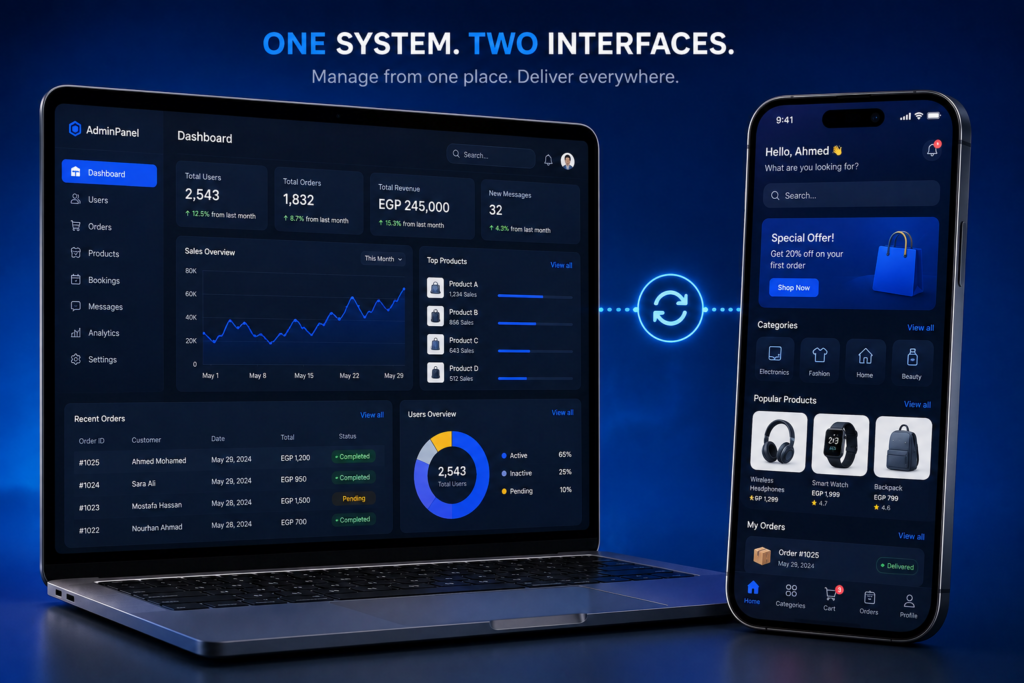
6. Admin Dashboard
One of the most commonly overlooked parts of an app project is:
The Admin Dashboard
If you have a commercial application, you will usually need a way to manage the system.
For example:
- Add and manage users.
- Edit products.
- Manage orders.
- Manage bookings.
- Send notifications.
- Manage content.
- View reports.
- Control permissions.
Without an admin dashboard, you may need developer involvement for every operational change.
That’s rarely practical when the application is an important part of your business.
7. Online Payments
If the application involves transactions, you may need payment integration.
This could include:
- Product payments.
- Subscription payments.
- Booking payments.
- Payment status management.
- Payment confirmation.
- Order status updates.
However, you should distinguish between:
The development cost of integrating a payment gateway
and
The fees charged by the payment provider.
They are not the same thing.
You also need to choose a payment provider that fits your target market and business model.
8. Notifications
Does your application need notifications?
For example:
- Booking confirmation.
- Order updates.
- New messages.
- New offers.
- Appointment reminders.
- Order status changes.
Notifications can be an important part of the user experience, but they should be connected to actual business logic.
Not every application needs a large notification system.
9. Maps and Location
If your application depends on location, you may need:
- Maps.
- Location services.
- Nearby services.
- Delivery tracking.
- Address selection.
- Distance calculation.
- Service coverage areas.
These features can increase the complexity of an application, especially when they are connected to delivery, logistics, or booking workflows.
10. Integrations With Other Systems
If your business already has systems in place, the application may need to connect to them.
For example:
- ERP.
- CRM.
- Website.
- E-commerce platform.
- Accounting system.
- Payment gateway.
- Shipping provider.
- SMS provider.
- Email platform.
For example:
Mobile App
↓
API
↓
ERP
↓
Inventory
↓
Order
If your workflow looks like this, you’re not simply building an app.
You’re building one part of a larger technology ecosystem.
11. Security
Security becomes especially important when your application handles:
- Personal information.
- User accounts.
- Payments.
- Sensitive data.
- Multiple permission levels.
The project may need to consider:
- Authentication.
- Authorization.
- Secure APIs.
- Data protection.
- Session management.
- Access control.
Security shouldn’t be treated as something you add at the very end.
It should be considered from the beginning of the project.
12. Testing
Before launching the application, it needs proper testing.
Not just:
“Does the app open?”
You need to test questions such as:
- Does login work?
- Does checkout work?
- What happens if payment fails?
- Does the app work across different screen sizes?
- What happens with a weak internet connection?
- Are notifications delivered?
- Is the data displayed correctly?
- Can users complete the entire workflow?
The more complex the application, the more important testing becomes.
13. Maintenance and Updates
App development doesn’t necessarily end when the application launches.
After launch, you may need:
- Bug fixes.
- Security updates.
- Operating system compatibility updates.
- Performance improvements.
- New features.
- Server maintenance.
- Database management.
- Technical support.
This matters because operating systems, devices, platforms, and technologies continue to change.
Do You Need Android and iOS From Day One?
Not necessarily.
If your business model is still being tested, it may make more sense to start with a focused scope and validate:
- Do people actually need the product?
- Are users actively using the application?
- Does the business model work?
- Which features do users actually use?
Then you can expand.
This can be more efficient than investing in a large application before you have evidence that the product has market demand.
Does an MVP Mean a Low-Quality App?
No.
An MVP doesn’t mean building a bad application.
It means identifying:
What is the smallest set of features that can achieve the core goal of the project?
For example, if you’re building a booking application, you may not need to launch with:
- Loyalty programs.
- Advanced analytics.
- Referral systems.
- Complex automation.
You might start with:
Accounts + Search + Booking + Notifications + Admin Dashboard
Then use real user data to determine what deserves further development.
When Do You Need a Custom Mobile App?
Custom development makes sense when your requirements cannot be properly handled by existing solutions.
For example:
- Custom business logic.
- Complex workflows.
- Multiple user roles.
- Multiple integrations.
- Custom dashboards.
- Marketplaces.
- Specialized booking systems.
- Applications connected to internal systems.
- Specific performance or security requirements.
But once again:
Custom development isn’t the goal by itself.
Technology should serve the business.
How Should You Compare Mobile App Development Quotes?
If three companies send you three different prices, don’t compare the numbers alone.
Compare what’s actually included.
| Item | What to Ask |
|---|---|
| Android | Is it included? |
| iOS | Is it included? |
| UI/UX | Is the design custom? |
| Backend | Is backend development included? |
| Admin Dashboard | Is it included? |
| Payments | Is integration included? |
| Notifications | Are they included? |
| API | Is API development/integration included? |
| Testing | Is QA included? |
| Deployment | Is publishing included? |
| Support | How long and what does it cover? |
| Future Features | How are they priced? |
You may find a cheaper offer, only to discover later that the features you actually need were excluded.
The Biggest Mistake: Choosing the Cheapest Price
The cheapest offer isn’t always the best.
But the most expensive offer isn’t automatically the best either.
The real question is:
What value will this project create compared with its cost?
For example, an application may reduce manual work, create a new sales channel, improve customer service, or simplify business operations.
The investment should therefore be evaluated against the business value—not simply the number of screens.
So, How Much Does Mobile App Development Cost in Egypt in 2026?
There is no single accurate price without knowing the project scope.
A simple application with limited functionality can be completely different from a full commercial application with a sophisticated backend, admin dashboard, and multiple integrations.
That’s why instead of asking:
“How much does a mobile app cost?”
the better question is:
“What exactly does the application need to do?”
Once you define:
Features + Platforms + Backend + Dashboard + Integrations + Design + Testing
you can create a much more accurate project scope and estimate.
How Should You Start a Mobile App Project?
Before development begins, define:
1. The App’s Goal
What problem will the application solve?
2. The User
Who will use it?
3. The Core Workflow
What does the user need to accomplish?
4. Must-Have Features
What absolutely needs to be included in the first version?
5. Nice-to-Have Features
What can wait until later?
6. Required Integrations
Does it need to connect to a website, ERP, CRM, payment system, or another platform?
7. Platforms
Android? iOS? Both?
8. Administration
Who will manage users, content, orders, bookings, and data?
Answering these questions will give you a much clearer understanding of the project’s actual size.
Conclusion
Mobile app development cost isn’t determined simply by the word “app.”
It depends on:
Application Type
↓
Features
↓
UI/UX
↓
Android + iOS
↓
Backend
↓
Admin Dashboard
↓
Payments
↓
Integrations
↓
Security
↓
Testing
↓
Maintenance
The right decision isn’t necessarily to choose:
The cheapest company
or:
The most expensive company
The better approach is to choose the right technical solution for your business and its current stage.
If your project is still at an early stage, an MVP may be the smarter option.
If you already have an established business with complex requirements, you may need a complete application connected to your existing systems.
And if your requirements don’t justify custom development, there’s no reason to pay for a custom system simply because it sounds more advanced.
Start with the business requirements, choose the technology second, and determine the cost based on the actual scope.
If you have an app idea and aren’t sure whether you need an MVP, a full mobile application, or a different technical solution, talk to CraftPress and define the right project scope before development begins.
Frequently Asked Questions
How much does it cost to build a mobile app in Egypt?
There is no fixed price. The cost depends on the type of application, number and complexity of features, design, Android and iOS requirements, backend, admin dashboard, integrations, testing, and support.
Is Android app development more expensive than iOS?
The cost can vary depending on the development approach and project requirements. The important thing is to define the required platforms and choose a technology that fits the application.
Do I need to build Android and iOS at the same time?
Not necessarily. The right approach depends on your audience, business model, and project stage. In some cases, starting with a narrower scope can be a smart way to validate the idea.
What is the difference between an MVP and a full mobile app?
An MVP contains the minimum set of features required to test the idea and achieve its core purpose. A full application may include more advanced features, integrations, workflows, and functionality.
Are the backend and admin dashboard included in mobile app development costs?
Not necessarily. You should confirm the project scope before signing a contract because some quotes cover only the mobile application while backend development and the admin dashboard are priced separately.
Does a mobile app need maintenance after launch?
Usually, yes. Applications may require updates, bug fixes, performance improvements, compatibility updates, security work, and new features after launch.
Does every mobile app require custom development?
No. The right solution depends on the requirements. Some projects can use existing technologies or platforms, while applications with complex business logic may require custom development.
What should I prepare before requesting a mobile app development quote?
Prepare a clear description of the app idea, target users, core features, required platforms, integrations, and administration requirements. The clearer the scope, the more accurate the estimate can be.
Have a mobile app idea but don’t know where to start or how much it should cost?
Not every idea needs a large application from day one, and not every project requires the same technology.
CraftPress can help you define the requirements, choose the right technical approach, and establish the right project scope before development begins — whether you’re building an MVP, an Android and iOS application, or a fully custom software system.