If you have started looking for a website design company for your business, you may quickly run into a compare website design proposals : every company sends you a different proposal, and every proposal comes with a different price.
One company may quote $300, another $600, and another $1,000 or more.
So you naturally start asking:
What is the actual difference? Is the more expensive proposal really better, or am I simply paying more for the same thing?
The problem is that comparing website design companies based on the final price alone rarely gives you the full picture.
Two proposals may have very different prices because they include very different scopes, levels of customization, features, technologies, support, or development processes.
That is why, before choosing a website design company, you should compare what you are actually getting, not just how much you are paying.
In this guide, we will walk through the most important points to review when comparing website design proposals, so you can make a more informed decision and understand exactly what each company is offering.
1. Are You Actually Comparing the Same Scope?
This is the first and most important question.
Before deciding that one company is cheaper than another, make sure both companies are actually offering the same thing.
For example, one proposal might include:
- 5 pages.
- A pre-built design with basic customization.
- A contact form.
- Website setup and launch.
Another proposal might include:
- 10–15 pages.
- A custom design.
- Dedicated service pages.
- More advanced forms.
- Third-party integrations.
- Basic SEO setup.
- Performance optimization.
- Security configuration.
- Website management training.
- Post-launch support.
If you compare the final prices without comparing the scope, you are not really comparing the same product.
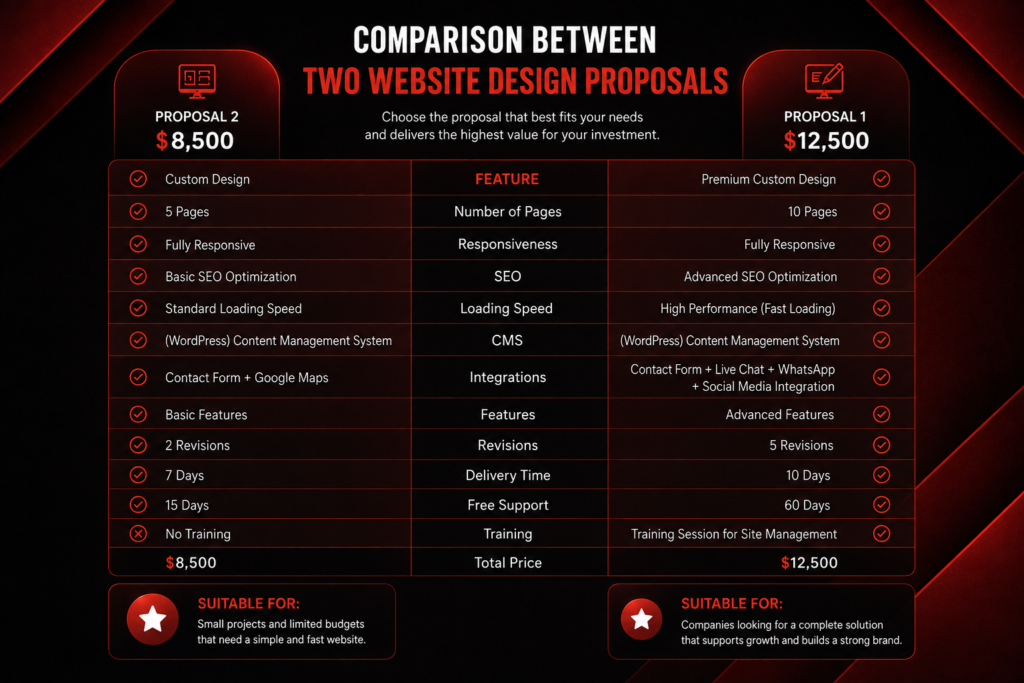
A simple comparison table can help
| Item | Proposal A | Proposal B |
|---|---|---|
| Number of pages | ? | ? |
| Custom design | ? | ? |
| Responsive design | ? | ? |
| Contact forms | ? | ? |
| Integrations | ? | ? |
| Basic SEO | ? | ? |
| Performance optimization | ? | ? |
| Post-launch support | ? | ? |
| Maintenance | ? | ? |
Not every project needs every item on this list.
The point is simply to understand what is included and what is not.
2. The Number of Pages Is Not the Whole Story
When a company tells you, “We will build 10 pages,” that number alone does not tell you much.
Ask:
Are all 10 pages individually designed?
Or are they based on the same template?
Are your services presented on individual pages?
Does each service have its own layout and content?
For example, a corporate website could include:
- Home
- About
- Services
- Individual service pages
- Projects
- Individual project pages
- Blog
- Contact
The actual number of pages can therefore become much larger than the initial list of main navigation items.
Some pages may also require custom functionality or a unique layout, which means they should not necessarily be evaluated in the same way as a simple informational page.
3. Is the Design Actually Custom?
This is another important point when comparing website design proposals.
There is a difference between taking an existing template and changing:
- Colors
- Images
- Fonts
- Text
- A few layout elements
and creating a more customized experience around the company’s brand, audience, and business objectives.
That does not mean using a template is always wrong.
For some projects, a high-quality template can be a perfectly reasonable solution, especially when the requirements and budget are limited.
But if your business needs a strong and differentiated online presence, you should understand exactly how much customization is included.
Ask the company:
- Is the design custom?
- Is UI/UX work included?
- Will the design reflect our brand identity?
- Is there a dedicated design phase?
- How many revision rounds are included?
These details can significantly affect both the cost and the final result.
4. What Features Are Actually Included?
Not every website is simply a collection of pages, images, and text.
Depending on your business, you may need:
- Contact forms.
- Appointment booking.
- User registration.
- Membership functionality.
- E-commerce.
- Payment gateways.
- Online courses.
- CRM integrations.
- WhatsApp integration.
- Google Maps.
- Analytics tools.
- Third-party systems.
- Custom dashboards.
- API integrations.
Each additional feature can affect the way the project is planned, developed, tested, and priced.
That is why saying:
“I need a website.”
is usually not enough to define a project.
You need to understand what the website is actually supposed to do.
And if you do not know which technology or solution you need, that is part of the website company’s job: helping you define the right solution before development starts.
5. Ask About the Technology — Not Just “WordPress or Not?”
One common mistake is starting the comparison with the name of the technology.
A better question is:
What technology is appropriate for this project, and why?
WordPress can be an excellent choice for many corporate websites.
Shopify may make more sense for certain e-commerce businesses.
A project with complex business logic, custom workflows, or advanced integrations may require custom development.
An educational business may need a dedicated LMS solution.
The right choice should start with:
Business Requirements → Features → Scalability → Budget → Integrations → Maintenance
Not:
“Someone told me WordPress is better.”
Technology should serve the business requirements, not the other way around.
For a deeper comparison, you can also read CraftPress’s guide on WordPress vs. Custom Development.
6. Is SEO Actually Included in the Proposal?
Simply writing “SEO-friendly website” in a proposal does not tell you enough.
Ask what the company actually means by SEO-friendly.
For example, does the project include:
- Clean URL structures?
- Metadata setup?
- XML sitemap?
- Indexability considerations?
- Mobile-friendly structure?
- Performance optimization?
- Structured data where appropriate?
- A content structure that can support SEO?
- Basic technical SEO configuration?
And is content writing included?
Is ongoing SEO included, or is that a separate service?
These are two very different things.
There is a major difference between building a website with a solid technical foundation for SEO and providing an ongoing SEO service.
Make sure the proposal makes that distinction clear.
7. Performance and Speed Should Be Part of the Conversation
A website can look impressive and still provide a poor experience if it is slow.
When comparing proposals, ask about:
- Mobile performance.
- Image optimization.
- File loading.
- Hosting environment.
- Caching where appropriate.
- JavaScript and CSS optimization where necessary.
- Core Web Vitals.
Performance should not be treated as an afterthought.
At the same time, do not choose a company simply because it promises a perfect PageSpeed score.
A better goal is a website that is fast, stable, usable, and appropriate for real visitors.
The number on a testing tool is useful, but it is not the business objective by itself.
8. What About Security, Backups, and Updates?
Ask what happens after the website goes live.
Who is responsible for:
- System updates?
- Plugin or dependency updates?
- Backups?
- Monitoring?
- Bug fixes?
- Security issues?
- Restoring the website if something goes wrong?
Different businesses will have different requirements.
If you have an internal technical team, you may need less external support.
If nobody on your team is technical, ongoing maintenance and support may be much more important.
The key is not that every company must offer the same service.
The key is that you know exactly what is included in your agreement.
9. What Happens After the Website Launches?
This is one of the questions business owners often forget to ask.
Some companies consider the project finished once the website is live.
Others may provide:
- Technical support.
- Maintenance.
- Updates.
- Bug fixes.
- New features.
- Future development.
There is no single correct answer for every business.
But if your website is an important part of your business, you should know what happens when something needs to be changed or fixed after launch.
Do not leave that question until after the project is finished.
10. Check Revisions and Change Requests
Ask clearly:
How many revision rounds are included?
And what happens if you request something outside the agreed scope?
For example:
“Can we change the button color?”
That may be a simple revision.
But:
“Let’s completely redesign this page, add an appointment system, and connect it to another platform.”
That is no longer a simple revision. It may be a change request that affects the scope, timeline, and cost.
Clear scope boundaries do not mean a company is inflexible.
They protect both sides from misunderstandings.
11. Review the Timeline and Project Process
Price is not the only factor that matters.
Time matters too.
Ask:
- When does the project start?
- What are the project stages?
- When is the design approved?
- When does development begin?
- When does testing happen?
- When is the website launched?
But do not automatically choose a company simply because it promises to build everything extremely quickly.
Projects are different.
A simple corporate website and a custom platform with multiple integrations should not have the same timeline.
A realistic timeline should be based on a clearly defined scope.
12. Make Ownership and Access Clear
Before signing the agreement, make sure you understand who owns and controls:
- The domain.
- Hosting.
- Website accounts.
- Analytics.
- Google Search Console.
- Business email.
- Design/source files when applicable.
- Software or plugin licenses related to the project.
You do not want to discover a year later that an important account is controlled by someone else’s personal email and you do not have proper access to it.
Clear ownership from the beginning is better for everyone.
Why Can a $300 Website Proposal and a $1,000 Proposal Both Be Reasonable?
Because website pricing is not determined by the amount of coding alone.
The difference may come from:
- Project size.
- Design quality and customization.
- Number of pages.
- Features.
- Integrations.
- Development complexity.
- Testing.
- Performance work.
- SEO foundation.
- Support.
- Project management.
That is why the right question is not:
“Which company is cheaper?”
The better question is:
“What am I getting for this price, and is it actually appropriate for my business?”
At the same time, a higher price does not automatically mean higher quality.
If two companies offer almost the same scope, ask why there is a significant price difference instead of assuming the more expensive option is better.
A Simple Website Proposal Comparison Checklist
Before choosing a company, use a checklist like this:
| Area | Questions to Ask |
|---|---|
| Scope | What exactly is included? |
| Pages | How many pages and what type? |
| Design | Template-based or custom? |
| Features | What functionality and integrations are included? |
| Technology | Why is this technology appropriate? |
| SEO | What SEO setup is included? |
| Performance | Is performance optimization part of the project? |
| Security | What security and update practices are included? |
| Revisions | How many revision rounds are included? |
| Timeline | What is the delivery process and timeline? |
| Ownership | Who owns the accounts and website assets? |
| Support | What happens after launch? |
| Price | Exactly what does the quoted price cover? |
This simple process can make comparing proposals much easier.
How Should You Actually Choose Between the Proposals?
If you want to simplify the decision, consider these factors in order:
1. Business Understanding
Did the company actually understand your business and objectives?
Or did they immediately start talking about pages, themes, and prices?
2. Scope
Is it clear what you will receive?
3. Technical Fit
Is the proposed technology appropriate for your requirements?
4. Relevant Experience
Does the company have projects similar to what you need?
5. Technical Quality
What about performance, security, SEO foundations, and user experience?
6. Communication and Project Management
Is there a clear process for communication, approvals, and delivery?
7. Post-Launch Support
What happens after the website goes live?
8. Price
Only after understanding all of the above should you compare the final price.
Not Every Business Needs the Same Website Solution
This is one of the most important things to understand before choosing a website company.
A business that needs a simple corporate website does not necessarily need the same solution as an academy selling online courses.
An e-commerce store is different from a real estate website.
A professional website is different from a platform that includes user accounts, online payments, and a custom dashboard.
That is why the right company is not necessarily the one offering the largest number of features.
The right company is the one that understands your requirements, recommends an appropriate solution, and clearly explains the scope, cost, and expectations before development begins.
If you want to see examples of real projects before making your decision, you can explore the CraftPress Projects portfolio and review the types of solutions that have been built.
Final Thoughts
Choosing a website design company should not be an auction based on price.
When you receive a $300 proposal and a $1,000 proposal, do not immediately ask:
“Which one is cheaper?”
Ask:
“Are these two companies actually offering the same scope?”
Compare the pages, design level, features, technology, SEO foundation, performance, security, support, timeline, ownership, and everything else included in the proposal.
Then look at the company’s previous work, communication, and understanding of your business.
Ultimately, choose the solution that fits your business goals, requirements, and realistic budget — not simply the lowest number on the page.
If you are planning a new website or considering a redesign of your existing website, you can contact CraftPress and share your project requirements with us. The first step is understanding what your business actually needs, then defining the appropriate solution, scope, and cost based on those requirements.
Frequently Asked Questions
Is the cheapest website design company the best choice?
Not necessarily. Price should be compared with the scope, quality, functionality, support, and other elements included in the proposal.
What is the most important thing to compare between website proposals?
Start with the scope. If two proposals include different pages, features, functionality, or levels of customization, comparing their prices alone is not meaningful.
Does every company website need WordPress?
No. The right technology depends on the project’s requirements, functionality, budget, integrations, scalability, and long-term maintenance needs.
Should SEO be included in website development?
It is a good idea to consider SEO from the beginning of the project. However, you should distinguish between building an SEO-friendly technical foundation and providing ongoing SEO services.
Does a higher website price mean better quality?
Not automatically. Ask what is causing the price difference and what additional value, functionality, customization, or support is included.
Is post-launch website support important?
It depends on your business. If you have an internal technical team, you may need less external support. If you do not, ongoing technical support and maintenance can be valuable.
What should a website design proposal include?
At minimum, it should clearly explain the scope, pages, features, technology, revisions, timeline, post-launch support, ownership, and exactly what the quoted price includes.
How many website design proposals should I compare?
There is no mandatory number. The important thing is to compare clear proposals that are detailed enough to evaluate fairly, rather than collecting a large number of vague quotes.