Choosing a web design company in Egypt is not a decision you should make simply because a company has attractive designs or offers the lowest price.
A website is much more than a collection of pages with images and company information.
For many businesses, the website is an important part of marketing, lead generation, sales, customer communication, and brand credibility. In some cases, it can also handle payments, bookings, e-commerce, customer accounts, or integrations with other business systems.
That means the company you choose to design and develop your website can affect your business for years.
The problem is that once you start searching, you’ll find plenty of agencies and freelancers offering web design and development services in Egypt. Almost everyone says:
“Professional, fast, responsive, and SEO-friendly websites.”
But how do you know which company is actually right for your project?
How do you compare a 10,000 EGP proposal with a 30,000 or 50,000 EGP proposal?
And how do you determine whether you need WordPress, Shopify, WooCommerce, or custom development?
Most importantly:
How do you choose a company that helps you achieve a business goal instead of simply delivering a website that looks good?
In this guide, we’ll walk through the most important questions and criteria you should consider before hiring any web design and development company.
First: Don’t Start by Asking “Who’s the Cheapest?”
One of the most common mistakes business owners make is starting the comparison like this:
“This company will build it for 10,000 EGP, another wants 20,000 EGP, and another wants 40,000 EGP. Which one should I choose?”
Price alone isn’t enough.
There can be a major difference between the projects being offered.
One company may provide:
- A ready-made template.
- A limited number of pages.
- Basic functionality.
- Basic hosting.
While another may include:
- Custom UX.
- Custom design.
- Custom development.
- Integrations.
- Technical SEO setup.
- Performance optimization.
- Migration.
- Training.
- Maintenance and support.
That’s why the right comparison starts with:
What’s actually included in the project?
Then:
Who can execute it properly?
And only then:
How much does it cost?
If you want to understand what actually affects website development pricing, you can also read our guide to website development cost.
1. Does the Company Actually Understand Your Business?
One of the first questions you should ask is:
Is the company trying to understand your business, or is it selling the same website to every client?
A real estate company has different requirements from a restaurant.
A doctor has different requirements from an educational academy.
A B2B manufacturer may need its website primarily for lead generation rather than simply presenting company information.
And an e-commerce business has an entirely different set of requirements involving:
- Products.
- Payments.
- Shipping.
- Inventory.
- Customer accounts.
- Orders.
- Marketing automation.
A professional web development company should ask about:
- Your business.
- Your target audience.
- Your services or products.
- Your competitors.
- Your website goals.
- How you currently generate leads.
- Required integrations.
- Future requirements.
If the first question you hear is:
“What colors do you want?”
before anyone asks:
“What is the goal of the website?”
that’s worth thinking about.
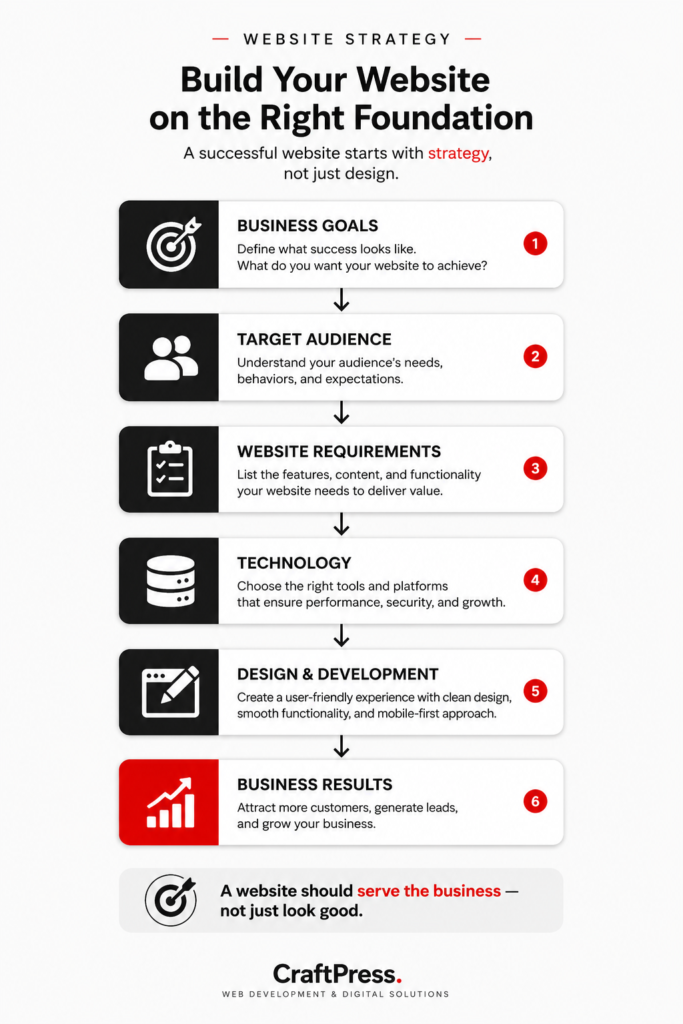
2. Does the Company Start With Business Goals or Design?
A website’s purpose isn’t to win a design competition.
Its purpose is to support the business.
That means design should be a tool for achieving a specific objective.
For example, if the primary goal is lead generation, you may need:
- Clear landing pages.
- Effective forms.
- Strong calls to action.
- Trust signals.
- Case studies.
- CRM integration.
If the goal is selling products, your priorities will be different.
You may need:
- Strong product pages.
- A suitable checkout.
- Payment gateways.
- Shipping integration.
- Customer accounts.
- Order management.
If the goal is booking, you may need a booking system or integration with an external platform.
So before asking:
“What will the website look like?”
ask:
“What should the website actually do for the business?”
3. Who Will Actually Build the Website?
This is another question many clients don’t ask.
You may hire an agency, but the actual project might be handled by:
- An external freelancer.
- Another development team.
- A junior developer.
- A third-party provider.
None of these is automatically a problem.
What matters is that you understand who is responsible for execution.
Ask:
- Who is the designer?
- Who is the developer?
- Who is the project manager?
- Who handles QA?
- Who handles the project after launch?
- Who is your main point of contact?
The important thing is accountability.
Using an external team isn’t necessarily bad.
The problem is when you don’t know:
Who is responsible if something goes wrong?
4. Does the Company Choose Technology Based on Your Requirements?
This is one of the strongest signs of a professional technology partner.
Not every project needs WordPress.
Not every e-commerce business needs WooCommerce.
Not every project requires custom development.
And not every online store needs Shopify.
Technology should be selected after understanding the requirements.
For example:
WordPress can be an excellent choice for corporate websites, content-driven websites, blogs, and many businesses that need flexible content management.
WooCommerce can be suitable for many stores that need flexibility and customization within WordPress.
Shopify can be a strong option for businesses that want a hosted e-commerce platform with built-in commerce functionality.
Custom development may make more sense when the project requires highly specialized functionality, complex workflows, or an architecture that doesn’t fit an off-the-shelf solution.
So if a company tells you:
“We build everything with WordPress.”
or:
“We build everything custom.”
without first asking about your requirements, that isn’t necessarily a sign of technical strength.
Sometimes it’s the opposite.
A strong technology partner should be able to tell you:
“Based on your requirements, this is the most appropriate solution, and here’s why.”
If you’re deciding between WordPress and custom development, read our guide to WordPress vs. Custom Development.
5. Is SEO Part of the Project From the Beginning?
This is extremely important.
You can receive a beautiful website and then ask:
“Why isn’t it ranking on Google?”
SEO isn’t a button you switch on after the website launches.
Many decisions made during planning and development can affect the website’s ability to perform in search.
These can include:
- Site structure.
- URLs.
- Page structure.
- Internal linking.
- Website speed.
- Mobile experience.
- Technical SEO.
- Metadata.
- Sitemap.
- Canonical URLs.
- Content management.
And when a company tells you:
“The website is SEO-friendly,”
that doesn’t necessarily mean they’re providing a complete SEO strategy.
Ask specifically:
“What SEO work is included in the project?”
If you’re replacing an existing website that already has rankings and organic traffic, also ask:
“What’s the plan for protecting our existing SEO?”
If URLs will change, Google recommends planning the site move carefully, mapping old URLs to new URLs, implementing appropriate redirects, updating important site signals, and monitoring performance after the migration. Google Search Central — Site Moves with URL Changes
6. Does the Company Have Real Projects You Can See?
Any company can say:
“We build professional websites.”
But it’s much better to see actual work.
Ask for:
- A portfolio.
- Live websites.
- Projects similar to yours.
- Different examples of design.
- Projects with functionality similar to what you need.
But remember an important point:
The number of projects isn’t the only criterion.
One hundred simple websites aren’t necessarily better than ten strong and technically complex projects.
What matters is:
Does the company have experience with the type of project you actually need?
7. What Exactly Is Included in the Proposal?
This is one of the most important questions to ask before signing anything.
The phrase:
“Website Design & Development”
can mean completely different things from one company to another.
Ask for the proposal to clearly define:
Design
- Number of pages.
- Whether the design is custom.
- Number of revision rounds.
- Responsive design.
Development
- CMS or technology.
- Core functionality.
- Integrations.
- Forms.
- User accounts if required.
Content
- Is copywriting included?
- Is content uploading included?
- Are images included?
SEO
- Technical SEO.
- Metadata.
- Sitemap.
- Redirects.
- SEO migration.
Launch
- Domain.
- Hosting.
- SSL.
- Deployment.
After Launch
- Training.
- Maintenance.
- Support.
- Bug fixes.
Everything should be clear.
One of the biggest problems in website projects is discovering after signing the contract that a feature you assumed was included is actually considered:
“An additional feature.”
8. Who Owns the Website, Domain, Hosting, and Data?
This is extremely important.
Before signing, make ownership and access clear.
Ask:
- Who owns the domain?
- Who owns the hosting account?
- Will the website be fully handed over?
- Will you have administrator access?
- Do you own the database?
- Do you own the website files?
- Can you move the website to another provider in the future?
The fact that a company built your website doesn’t necessarily mean it should permanently control every part of your digital infrastructure.
Make sure ownership, access, and responsibilities are clearly defined in the agreement.
Especially if the website is an important business asset.
9. What Happens After the Website Launches?
The website doesn’t stop being important once it goes live.
After launch, you may need:
- Updates.
- Backups.
- Security monitoring.
- Bug fixes.
- Performance optimization.
- Content updates.
- Technical support.
- New feature development.
Ask:
“Do you provide post-launch support?”
And if the answer is yes:
“Exactly what does that support include?”
Also understand the difference between:
Warranty
and
Maintenance
and
Ongoing Development
They aren’t the same thing.
10. How Should You Compare Different Web Design Proposals?
Imagine you receive three proposals:
Company A — 10,000 EGP
Company B — 20,000 EGP
Company C — 35,000 EGP
Don’t choose based on the number alone.
Create a comparison table:
| Element | Company A | Company B | Company C |
|---|---|---|---|
| Custom Design | ? | ? | ? |
| Responsive | ? | ? | ? |
| CMS | ? | ? | ? |
| SEO | ? | ? | ? |
| Integrations | ? | ? | ? |
| Content | ? | ? | ? |
| Speed Optimization | ? | ? | ? |
| Training | ? | ? | ? |
| Maintenance | ? | ? | ? |
| Support | ? | ? | ? |
| Ownership | ? | ? | ? |
| Timeline | ? | ? | ? |
Once you do this, the differences between proposals become much clearer.
The cheapest proposal may simply have a smaller scope.
The most expensive proposal may contain things you don’t actually need.
The goal isn’t to choose the cheapest or most expensive company.
The goal is:
Choose the best value for your project’s actual requirements.
Red Flags That Should Make You Think Twice
Not every cheap company is bad.
And not every expensive company is excellent.
But some warning signs deserve closer attention.
1. Extremely Low Pricing With No Clear Scope
If someone says:
“We’ll build you a complete professional website with everything included.”
for an unusually low price, ask:
What’s actually included?
2. Unrealistic Promises
For example:
“We’ll guarantee you the first position on Google.”
or:
“The website will double your sales.”
A professional company should distinguish between:
What it can control
and
What depends on the market, competition, customer behavior, and other variables.
3. Focusing Only on Design
If every conversation revolves around:
- Colors.
- Animations.
- Visuals.
- Fonts.
but nobody discusses:
- Business goals.
- UX.
- SEO.
- Performance.
- Conversion.
- Technology.
then something important is missing.
4. No Clear Portfolio
If the company cannot show real projects or verifiable examples, ask yourself:
How am I supposed to evaluate the quality of their work?
5. Every Website Looks the Same
If every project looks almost identical, the company may be using a standardized template or process.
That isn’t automatically bad.
But you should still ask:
Is the solution actually designed around my business and requirements?
The Cheapest Price Isn’t Always the Best Deal
Imagine you have two companies.
The first quotes:
10,000 EGP
The second quotes:
20,000 EGP
If both offer essentially the same scope and quality, naturally the lower price is attractive.
But imagine the first company provides:
- Template-based design.
- Five pages.
- No content support.
- No SEO migration.
- No integrations.
- Limited support.
While the second provides:
- Custom design.
- UX planning.
- Development.
- SEO setup.
- Integrations.
- Training.
- Support.
You’re not really comparing:
10,000 vs. 20,000
You’re comparing:
Two different services.
That’s an important distinction.
Can the Website Grow With Your Business?
Ask the company:
“If our business grows over the next year, can this website grow with us?”
For example, you may start with a simple corporate website and later need:
- A blog.
- Landing pages.
- CRM integration.
- Booking.
- A customer portal.
- E-commerce.
- Multilingual content.
Can the current architecture support those changes?
You don’t necessarily need to build everything on day one.
But the technical partner should have a clear understanding of:
How the project can evolve over time.
That’s an important part of choosing the right architecture.
What Should You Receive at the End of the Project?
Before making the final payment, make sure you know exactly what will be delivered.
Depending on the project, this may include:
- The completed website.
- Administrator access.
- Domain access.
- Hosting access.
- Source files if included in the agreement.
- Database.
- Documentation.
- Analytics setup.
- Search Console setup.
- Tracking setup.
- Training.
- Credentials.
- Backups.
- Technical documentation.
Not every project needs every item.
What matters is that your ownership and deliverables are clearly defined.
Website Development Company Checklist
Before signing a contract, ask yourself:
About the Company
☐ Have I seen real projects?
☐ Do they have experience with projects like mine?
☐ Do I know who will actually build the website?
About Strategy
☐ Do they understand my business goals?
☐ Have we defined the target audience?
☐ Have we agreed on what the website needs to accomplish?
About Technology
☐ Do I understand why this technology was chosen?
☐ Can the solution scale?
☐ Are the required integrations clearly defined?
About SEO
☐ Is SEO included in the scope?
☐ Are the URLs being considered?
☐ Is there a migration plan if the current website is being replaced?
About Pricing
☐ Is the scope written clearly?
☐ Are additional costs clear?
☐ Are revision rounds defined?
☐ Is the timeline clear?
About Ownership
☐ Do I own the domain?
☐ Do I have the necessary access?
☐ Do I own the website and its data?
After Launch
☐ Is support available?
☐ Is maintenance available?
☐ Is training included?
☐ Is responsibility for post-launch problems clearly defined?
If you can answer these questions before signing, you’ve already reduced a significant part of the risk involved in choosing a web development company.
Do You Need the Biggest Web Design Company?
Not necessarily.
A very large agency may be excellent, but it isn’t automatically the best choice for every project.
A smaller company can be an excellent fit if it has:
- Relevant experience.
- A clear process.
- Good communication.
- Strong execution.
- Business understanding.
- Reliable support.
- Appropriate technology expertise.
The important question isn’t simply:
How big is the company?
It’s:
Is the company right for your project?
Does the Company Need to Specialize in WordPress?
Not necessarily.
If WordPress is the right solution for your project, that’s great.
But if your requirements are better suited to Shopify, WooCommerce, custom development, or another architecture, the company should be able to evaluate those alternatives.
Your goal isn’t to buy:
A WordPress website.
Your goal is to buy:
The right website for your business.
That’s a major difference.
The Bottom Line: Choose a Technology Partner, Not Just a Vendor
One of the most important questions you can ask a web design company is:
“Are you going to simply build what I ask for, or will you help me determine what I actually need?”
The best website project doesn’t necessarily start with the best visual design.
It usually starts with the best understanding of the problem.
The right technology partner should help you understand:
- What the website needs to accomplish.
- Who the audience is.
- Which technology makes sense.
- Which features are actually necessary.
- What can be postponed.
- How to protect existing SEO.
- How the website can scale.
- What you’ll need after launch.
Ultimately, you’re not just buying a website.
You’re investing in a digital business asset that should help your company grow.
If you’re planning a new website or considering rebuilding your existing one, explore CraftPress web design and development services and see CraftPress projects.
If you already have a project in mind, contact CraftPress.
Frequently Asked Questions
How do I choose the best web design company in Egypt?
Start by defining your project requirements, then evaluate companies based on relevant experience, quality of previous work, proposed technology, scope, SEO, post-launch support, ownership, and overall value—not price alone.
How much does website design cost in Egypt?
There is no fixed price for every website. Cost depends on the type of website, number of pages, design requirements, technology, functionality, integrations, content, and support requirements. See our guide to website development cost for the factors that affect pricing.
Does every web design company use WordPress?
No. Some projects are well suited to WordPress, while others may be better served by WooCommerce, Shopify, custom development, or another solution depending on the requirements.
Should SEO be included in a website development project?
SEO should ideally be considered from the beginning, especially when the website is expected to generate organic traffic. Decisions involving site structure, URLs, performance, and content can all affect SEO.
What is the difference between web design and web development?
Web design focuses primarily on the visual experience and user experience, while web development involves building the functional website, implementing features, connecting databases and integrations, and making the design work technically.
Do I need a large agency to build a professional website?
Not necessarily. Relevant experience, quality, communication, process, technical capability, and support are generally more important than company size alone.
What should I review in a website development proposal?
Review the scope in detail, including pages, design, development, functionality, integrations, SEO, content, timeline, revisions, support, maintenance, and ownership.
Should a web design company provide post-launch support?
Post-launch support can be valuable, but you should understand exactly what it includes, how long the warranty lasts, and whether ongoing maintenance or additional development is included separately.
CTA
Looking for a web design company but don’t want to choose based only on price or appearance?
At CraftPress, we start by understanding your business requirements and objectives, then determine the technology, functionality, and approach that make the most sense for your project instead of forcing every client into the same solution.
Tell us about your project, and let’s determine the right way to build a website that actually supports your business.