
If you’re thinking about starting an online store, there’s a good chance you’ve come across Shopify more than once.
Maybe someone told you:
“Just build the store on Shopify.”
Or you’ve seen an online store using it and started comparing it with WordPress and WooCommerce.
But before choosing Shopify for your business, it’s important to understand what it actually is.
How does Shopify work?
What can you do with it?
Who is it suitable for?
What are its advantages and disadvantages?
And most importantly:
Is Shopify actually the right choice for your online store?
In this guide, we’ll explain Shopify from the ground up in practical terms, without assuming that you’re a developer or have previous technical experience.
What Is Shopify?
Shopify is an e-commerce platform that allows businesses to create and manage online stores and sell products through a centralized system.
In simple terms, instead of building an entire e-commerce system from scratch, Shopify provides much of the infrastructure you need to run an online store.
You can use it to:
- Add products.
- Manage inventory.
- Process orders.
- Manage customers.
- Organize sales.
- Build an online storefront.
- Sell through different channels.
- Add additional functionality through apps.
- Manage many aspects of your store from one dashboard.
Shopify describes itself as a commerce platform for selling online and in person, with tools for products, inventory, orders, shipping, marketing, and analytics. (Shopify)
So Shopify isn’t simply a website builder.
It’s primarily a commerce platform.
How Does Shopify Work?
The basic concept is relatively simple.
Instead of starting with:
Server + CMS + E-commerce System + Checkout + Security + Hosting
and building or configuring every component yourself, Shopify provides much of the infrastructure as a managed service.
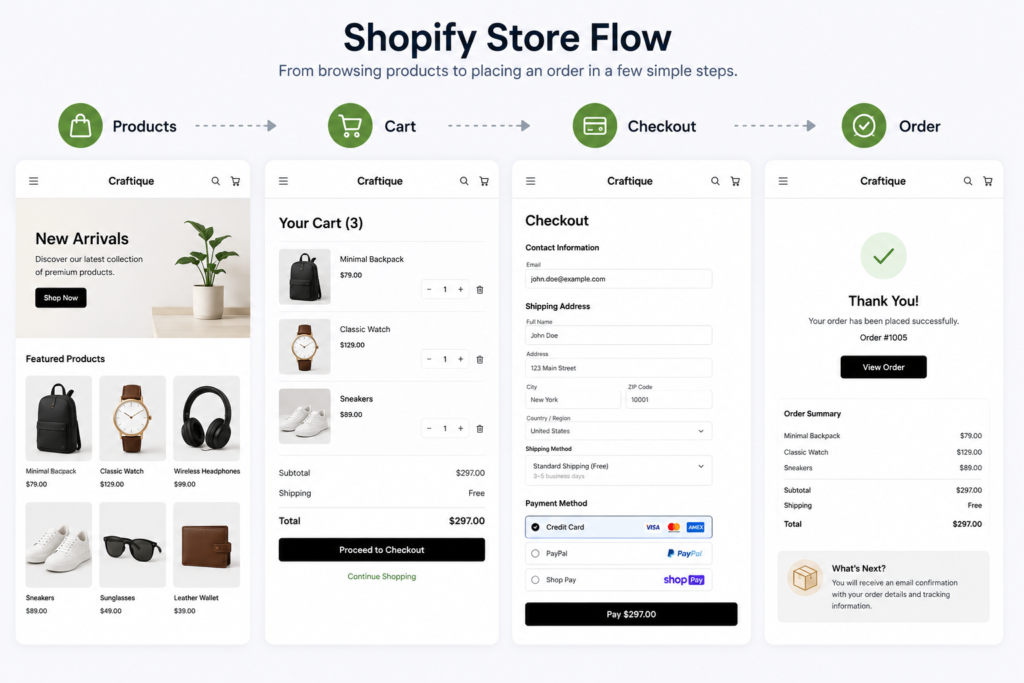
You start by creating your store, then:
Choose the design
↓
Add your products
↓
Configure prices and inventory
↓
Set up payment and shipping options
↓
Prepare the storefront
↓
Start selling
After that, you use the Shopify admin to manage products, orders, customers, and other aspects of the business.
Shopify also provides themes, apps, and tools for selling through different channels. (Shopify Help Center)
Do You Need to Be a Developer to Use Shopify?
No.
That’s one of Shopify’s biggest advantages.
The platform is designed so that you can launch an online store without being a developer.
You can start with a ready-made theme and customize significant parts of the storefront through Shopify’s tools.
At the same time, if your project requires more advanced customization, Shopify provides APIs and developer tools that allow developers to build more customized experiences and integrations. (Shopify)
This means you can have different levels of customization:
Ready-Made Theme
↓
Customized Shopify Store
↓
Advanced Customization
↓
Headless / Custom Shopify Architecture
So you’re not limited to choosing between:
“A ready-made theme”
and
“Building everything from scratch.”
There are several levels in between.
What Can You Do With Shopify?
Shopify is built primarily around e-commerce, so it offers a wide range of features related to selling online.
You can, for example:
Manage Products
Add:
- Product names.
- Descriptions.
- Images.
- Prices.
- Inventory.
- Variants.
Manage Orders
You can track and manage customer orders through the Shopify admin.
Manage Inventory
If your business has multiple products or inventory locations, Shopify provides inventory management features, with specific functionality depending on your plan and requirements. (Shopify Pricing)
Accept Payments
Shopify provides payment-related tools, but the payment options available to you depend on your country, store configuration, and payment provider.
This is especially important if you’re planning to operate a store in Egypt.
Don’t assume that every payment gateway is available through Shopify in every country in exactly the same way.
Before choosing the platform, verify that the payment provider you want to use is compatible with your Shopify store.
Manage Shipping
Shopify provides shipping-related tools, with available features depending on your location, plan, and shipping providers. (Shopify Pricing)
Sell Through Multiple Channels
Shopify isn’t limited to your website.
The platform supports selling through multiple channels, including online and in-person sales and certain social and marketplace channels, depending on your configuration and location. (Shopify)
The Main Advantages of Shopify
1. It’s Relatively Easy to Get Started
One of Shopify’s biggest advantages is that you don’t have to build the entire infrastructure of your store yourself.
This can reduce the technical complexity and time required to launch.
2. It’s Built Specifically for E-Commerce
This is an important distinction.
Shopify isn’t a general-purpose CMS that simply had e-commerce added to it.
It’s fundamentally built around:
Commerce
That makes it a strong option for many types of online stores.
3. Ready-Made Themes Can Be Customized
You can start with a theme and customize its appearance to match your brand.
Shopify provides themes and tools for customizing storefronts, while developers can also create more advanced custom themes when a project requires greater control. (Shopify Help Center)
4. Shopify Has a Large App Ecosystem
If you need additional functionality, Shopify has an App Store with applications that extend the capabilities of your store.
You can find apps for things such as:
- Marketing.
- Reviews.
- Product Options.
- Email.
- Loyalty.
- Analytics.
- Shipping.
- Customer Support.
Shopify highlights a large ecosystem of apps that can be used to extend store functionality. (Shopify)
But there’s an important point here:
Apps don’t mean every feature should be solved with an app.
Every app you add can introduce:
- Additional cost.
- Performance considerations.
- Dependencies.
- Configuration requirements.
- Compatibility concerns.
That’s why apps should be selected carefully.
5. Shopify Can Support International Selling
If you plan to sell in multiple countries, Shopify provides tools related to international selling, currencies, languages, and markets, with specific capabilities depending on your plan and location. (Shopify Pricing)
This can be useful for brands that have:
- Customers in different countries.
- Multiple currencies.
- Multiple markets.
- Localized selling requirements.
6. You Can Start Small and Scale
Shopify offers multiple plans designed for different business needs.
Its current pricing page includes plans such as:
- Basic
- Grow
- Advanced
- Plus
with pricing and features varying by plan, billing cycle, and location. (Shopify Pricing)
This gives some businesses the ability to start with a plan that fits their current needs and move to a higher level as the business grows.
Is Shopify Free?
No.
Shopify is a subscription-based platform.
Pricing varies depending on the plan, billing cycle, and location, along with certain payment and transaction-related fees depending on the payment method and configuration. (Shopify Pricing)
So when calculating the cost of a Shopify store, don’t look only at:
Website design cost.
Consider:
Shopify Subscription
Design / Development
Apps
Payment Fees
Domain
Marketing
Maintenance / Development
This gives you a much more realistic view of the project’s total cost.
Is Shopify Suitable for an Online Store in Egypt?
It can be, but there isn’t a universal yes for every Egyptian store.
You need to evaluate:
- Your payment method.
- Payment gateway.
- Shipping.
- Currency.
- Taxes.
- Invoicing requirements.
- Customer needs.
- Required integrations.
- Your business model.
This is particularly important because some Shopify features and services vary by country.
So if you’re operating in Egypt, don’t choose Shopify simply because:
“It’s popular.”
Instead ask:
“Can Shopify support my business workflow in the way I actually need?”
Shopify vs. WooCommerce
This is one of the most common questions.
And the answer is:
There is no universal winner.
The platforms are different.
Shopify
May be a strong fit if you want:
- A managed e-commerce platform.
- A relatively fast launch.
- Less responsibility for infrastructure management.
- A commerce-focused ecosystem.
- A platform designed specifically around online selling.
WooCommerce
May be a better fit if you want:
- WordPress.
- Content + E-commerce.
- Greater control over your website environment.
- Extensive customization.
- Deep integration with the WordPress ecosystem.
The decision should be based on requirements.
Not:
“I like WordPress.”
Or:
“Shopify is faster.”
Want to Learn More About Shopify?
If you want a deeper look at the platform, check out our Shopify Guide 2026.
This can be the next step after understanding the basics of Shopify.
The Disadvantages of Shopify
Shopify is a powerful e-commerce platform, but it isn’t perfect for every business.
1. You’re Dependent on the Platform
Shopify is a SaaS platform.
That means a significant part of the underlying infrastructure is managed by Shopify.
That’s convenient, but it also means you don’t have the same level of ownership and control over every infrastructure layer that you might have with a fully custom system.
2. Customization Has Limits
Shopify offers significant customization capabilities, but projects with highly complex business logic may eventually encounter limitations compared with building a completely custom system.
That doesn’t mean Shopify is weak.
It means:
Every technology has boundaries.
3. Apps Can Increase Your Costs
At first, you might think:
“I’ll just install an app.”
Then:
“One more app.”
Then:
“We need another app.”
Eventually, you may have a collection of recurring subscriptions.
That’s why you should consider the Total Cost of Ownership, not just the initial development cost.
4. Not Every Business Model Fits Shopify
If your project requires:
- Highly customized internal workflows.
- Complex business logic.
- A specialized marketplace.
- An internal operational system.
- Very unusual requirements.
you may need a different architecture.
When Is Shopify a Great Choice?
Shopify can be a strong choice when:
- The project is primarily e-commerce.
- The products and business processes are relatively clear.
- You want a relatively fast launch.
- You don’t need a highly complex internal system.
- You prefer a managed platform.
- Your requirements are compatible with Shopify.
- The required integrations are available or can be implemented appropriately.
In this scenario, Shopify can save significant time and development effort compared with building a commerce system from scratch.
When Might Shopify Not Be the Best Choice?
You may need to evaluate alternatives if your project includes:
- Complex custom business logic.
- Highly specialized integrations.
- Unusual user roles.
- Marketplace architecture.
- Internal business systems.
- Highly customized workflows.
- Requirements that cannot be implemented appropriately within Shopify.
Possible alternatives could include:
WooCommerce
or
Custom Development
or
A Hybrid Solution
The right choice depends on the project.
That’s why at CraftPress, we don’t start with:
“We build Shopify stores.”
We start with:
“What does your business actually need?”
Is Shopify Suitable for Large Online Stores?
It can be.
Shopify offers plans and capabilities for businesses at different scales, including Shopify Plus for larger and more complex operations. (Shopify Pricing)
But “large” by itself isn’t enough to make a technology decision.
You also need to consider:
- Number of products.
- Number of orders.
- Number of users.
- Number of markets.
- Integrations.
- Business logic.
- B2B requirements.
- Operational workflows.
In other words:
Store size alone doesn’t determine the technology.
Is Shopify Good for SEO?
Yes, Shopify stores can be optimized for SEO.
But using an SEO-capable platform doesn’t mean your store will automatically rank on Google.
You still need:
- Keyword Research.
- Product Page Optimization.
- Category Structure.
- Internal Linking.
- Content.
- Technical SEO.
- Page Speed Optimization.
- Structured Data.
- Digital PR and link building when appropriate.
- Conversion Optimization.
Shopify is the:
Technology
SEO is the:
Strategy + Execution
Does Shopify Require a Developer?
Not every store requires a developer on an ongoing basis.
You can launch a simple store using Shopify’s built-in tools and themes.
But if you need:
- Custom Themes.
- Custom Sections.
- Integrations.
- Custom Apps.
- Advanced Features.
- Performance Optimization.
- Migration.
- Custom Design.
then working with an experienced developer can save significant time and prevent technical problems.
This becomes especially important when the store is a core part of the business rather than a small experiment.
Is Shopify Better Than Building a Custom Store?
Not necessarily.
If you need a conventional online store with clear requirements, Shopify may be more than enough.
If you have a highly specialized commerce system, Custom Development may be more appropriate.
The right question isn’t:
Shopify vs. Custom — which one is better?
It’s:
Which solution can meet the requirements without introducing unnecessary complexity?
If Shopify can meet the requirements, why build everything from scratch?
And if Shopify can’t meet the core requirements, why force the project onto it?
What Should You Ask Before Choosing Shopify?
Before starting, create a simple checklist.
Products
- How many products will you have?
- Do products have variants?
- Do you need subscriptions?
- Are the products physical or digital?
Payments
- Which payment gateway will you use?
- Is it available in your country?
- What are the fees?
- Does it support your business model?
Shipping
- Which shipping provider will you use?
- Do you need multiple shipping methods?
- Is an integration required?
Customers
- Do customers need accounts?
- Do you need loyalty functionality?
- Do you serve B2B customers?
- Do you need wholesale functionality?
Integrations
- CRM?
- ERP?
- Accounting?
- Marketing Automation?
- Warehouse?
Growth
- Will you sell internationally?
- Do you need multiple currencies?
- Do you need multiple languages?
- Do you have plans to expand?
If the answers become increasingly complex, it’s worth conducting a technical assessment before committing to the platform.
Shopify Is More Than a Store Builder
This is one of the most important ideas in this article.
Shopify isn’t simply:
“A template for an online store.”
It’s a commerce platform that includes:
- Storefront.
- Product Management.
- Orders.
- Payments.
- Inventory.
- Marketing.
- Sales Channels.
- Apps.
- APIs.
- Integrations.
The platform also continues to evolve. Shopify’s Spring ’26 Edition announced more than 150 updates across commerce, selling, AI, development, and other areas. (Shopify Editions)
That means Shopify should be evaluated based on its current capabilities and your current business requirements—not on an outdated experience or something someone used several years ago.
So, Is Shopify Right for You?
If you’re asking:
“Is Shopify a good platform?”
The answer is:
Yes, Shopify is a powerful e-commerce platform.
But the more important question is:
“Is Shopify right for my business?”
That requires a different kind of analysis.
If you have an online store with relatively clear requirements and want a managed platform that can help you launch efficiently, Shopify may be an excellent choice.
If your business relies heavily on WordPress and content is a major part of the website, WooCommerce may make more sense.
If you have complex business logic or highly specialized requirements, Custom Development may be the better option.
There is no single technology that fits every business.
That’s why at CraftPress, we don’t start with the platform.
We start by understanding:
The Business
↓
The Requirements
↓
The Customer Journey
↓
The Integrations
↓
The Technology
And then we determine whether Shopify is actually the right choice.
If you’re considering a Shopify store and aren’t sure whether it’s suitable for your business, talk to CraftPress and let’s start with your business requirements before choosing the platform.
Frequently Asked Questions
What is Shopify?
Shopify is a managed e-commerce platform that allows businesses to create and operate online stores, sell products, and manage orders, inventory, and other commerce activities through one system.
Is Shopify free?
No. Shopify operates on a subscription model with different plans and features. There can also be payment and transaction-related fees depending on the plan and payment setup. (Shopify Pricing)
Do I need a developer to use Shopify?
Not necessarily. You can build a basic store using Shopify’s themes and built-in tools, but projects requiring advanced customization or integrations may benefit from an experienced Shopify developer.
Is Shopify suitable for stores in Egypt?
It can be, but you should verify that your preferred payment gateway, shipping provider, currency, tax requirements, and integrations work with Shopify and your specific business model in Egypt.
Is Shopify better than WooCommerce?
Not universally. Shopify is a managed e-commerce platform, while WooCommerce operates within WordPress and provides extensive flexibility. The right choice depends on the project’s requirements.
Is Shopify suitable for large online stores?
Yes, Shopify has plans and capabilities designed for larger businesses, including Shopify Plus. However, the right solution depends on the complexity of the business, not simply the number of products. (Shopify Pricing)
Can Shopify be customized?
Yes. Shopify supports customizable themes, APIs, developer tools, and more advanced development options depending on the project and requirements. (Shopify)
Is Shopify suitable for every online store?
No. Businesses with highly complex business logic, unusual workflows, specialized integrations, or custom operational systems may need WooCommerce, Custom Development, or another architecture.
Thinking about building a Shopify store but not sure whether it’s right for your business?
Before choosing a theme, paying for a subscription, or installing apps, let’s understand your business requirements first.
CraftPress can help you evaluate the right technology, design your Shopify store, handle customization and integrations, and build a shopping experience around your business goals.